
Joint First-To-Die Life Insurance in Canada: Pros and Cons

Joint first to die life insurance is a simple and cost effective way for couples to protect their family’s financial security. With one policy covering two people, the death benefit is paid out after the first insured person passes away, helping the surviving partner pay off debts, cover living expenses, or maintain their lifestyle.
This guide explains how joint first to die life insurance works, who it’s best for, the pros and cons, and how it compares to individual policies — so you can decide whether it’s the right solution for your family.
Joint Last-to-Die Life Insurance in Canada: How It Works & Costs

Joint last-to-die life insurance is a specialized form of permanent life insurance designed primarily for tax and legacy planning. While it isn’t right for everyone, it can be an extremely effective solution for couples who want to cover future taxes, preserve wealth, and leave a meaningful legacy to their heirs or favourite charities.
This guide explains how joint last-to-die—also known as second-to-die—life insurance works in Canada, who should consider it, how much coverage typically costs, and how it compares to other joint life insurance options.
Insuring the different stages of life
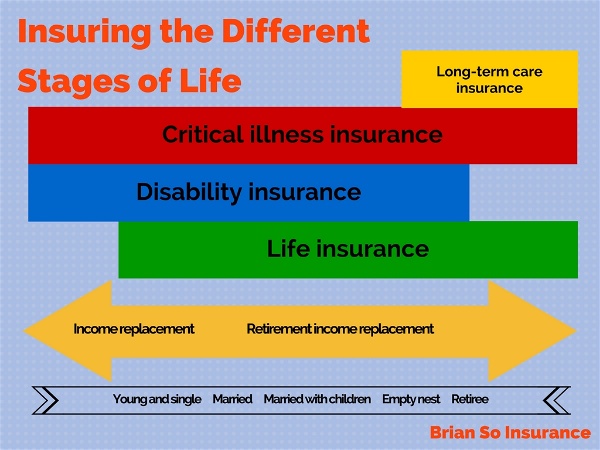
As we travel through the journey of life, our financial needs and obligations undergo constant change. For example, your financial obligations increase once you are married, and continue to do so as your family grows in size. It should come as no surprise that insurance varies in importance at different stages of life. Proper planning at each stage of life is necessary to ensure that you and your dependents are protected. Without knowing the risks and a plan to minimize the risk, you are potentially exposing your family to a financial disaster. Here are which types of insurance you should be aware of at each stage of life.
How Much Does Life Insurance Cost? A Comprehensive Guide To Pricing

Did you know that the cost of life insurance in Canada can range from as little as $10 per month to over $300, depending on your age, health, and coverage type? Many Canadians are unaware of how affordable—or expensive—term life insurance can be, leaving them unprepared when it comes time to protect their loved ones.
Life insurance premiums aren’t one-size-fits-all. Factors like your age, gender, lifestyle, smoking habits, and even your hobbies can significantly influence your premiums. Understanding these nuances is crucial for making informed decisions and finding a policy that fits your needs and budget.
Whether you’re a young professional just starting out, a parent with growing responsibilities, or someone approaching retirement, there’s a life insurance plan tailored for you—and likely more affordable than you think.
In this guide, we’ll break down exactly how much life insurance costs in Canada, explore the factors that impact premiums, and show you how to find the best rates. By the end, you’ll be equipped with the knowledge to make a confident, informed choice. Let’s dive in!
Wealth Transfer Using Life Insurance

Are you looking for a way to transfer your wealth to your children in the most efficient way possible?
Did you know you can do this with the wealth transfer strategy using life insurance?
With this strategy, you:
Reduce the tax you have to pay
Avoid costly probate and other estate fees
Can build up significant cash value inside the policy tax-sheltered
And much more.
So if you’re want to know more about how this strategy can help protect your wealth, this post is for you.
Let’s get started.
Estate Planning Using Life Insurance

This is the complete guide to estate planning using life insurance.
In this post, you will learn:
-What estate planning is
-How much tax, probate fees, and other costs your estate has to pay
-How life insurance is a cost-effective way to cover these expenses, preserving your estate for your loved ones
So if you’ve ever wondered how life insurance fits into your estate plan, you’re in the right place.
Charitable Giving Using Life Insurance

Charitable donations totaled $9.6 billion in 2017, and this number is on the rise.
But did you know that besides donating cash, you can also give the gift of a life insurance policy?
How does it work? And what are the tax benefits?
In this post, we’ll go over your options for charitable giving using life insurance. You’ll learn:
-Which method gives you a tax credit while you’re alive and which one gives it when you pass away
-What type of life insurance you should use for charitable giving
-How using life insurance can increase your contribution by 50% compared to other investments
Let’s begin.
Should you replace your life insurance policy?

Last week we looked at when you should perform a life insurance review. One of the suggestions that was brought up during a review was to replace your current policy if a new one would better serve your needs. How do you determine if a new policy is more suitable for you? In which way is it better? Worse? Is there a cash surrender value in the old policy that would trigger tax if you cancelled it? Would you qualify for a new policy for the same or better rate? These are all questions that you need to ask before replacing a life insurance policy.
Product review: Humania’s P.A.G.E.

A few posts back we reviewed Manulife’s Synergy, a 3-in-1 solution that encompasses life, critical illness and disability insurance. While it’s a simple product that covers the major risks in life, there isn’t much customization associated with it. Every Synergy policy must be comprised of the three types of insurance, with no way of mixing and matching the type of protection you want. That doesn’t mean there is no product with more customization available. Humania, a company based in Quebec, came up with a solution that satisfies all your customization needs by allowing you to mix and match to your heart’s content. The product is called P.A.G.E., and it’s short for ‘Protection for the entire family, Affordable rates, Global coverage, Easy application.’
Product review: Foresters’ Quit Smoking Incentive Plan

Are you a smoker who wants to kick the habit? Chances are, if you currently smoke, that thought has crossed your mind. Besides the health benefit of quitting, there are also financial incentives. The obvious one is saving the money you used to spend on cigarettes. According to Preet Banerjee’s new book, Stop Over-Thinking Your Money, a teenager who pays $9 for a pack of cigarettes would have amassed over $375,000 if he instead would have directed the money to an investment yielding 3%. Now, Foresters has another financial incentive for you to quit smoking. In this week’s product review, we will look at Foresters’ Familylife participating whole life insurance product and its automatically included rider – Quit Smoking Incentive Plan. Chances are you haven’t heard of Familylife before. That’s because it launched in April of 2013, so it’s a brand new product in the insurance industry, and it’s one of a kind in the Canadian marketplace.