Your ability to earn an income is the foundation of your financial life. Disability insurance protects that income—but qualifying becomes more complex when you have a medical history.
Insurers don’t just assess your health today. They evaluate how your past and current conditions could affect your ability to work in the future. This process—called medical underwriting—is where pre-existing conditions come into focus.
Bottom line:
You can often still get disability insurance with a pre-existing condition—but your outcome depends on how insurers assess your risk and how your application is positioned.
This guide explains what counts as a pre-existing condition in Canada, how underwriting works, and what you can realistically expect.
- Key takeaways:
- You can still qualify for disability insurance with many pre-existing conditions.
- Insurers care most about stability, severity, and recurrence risk.
- Most applicants are approved with modifications rather than declined.
- Even limited coverage can be improved later with the right strategy.
What Is a Pre-Existing Condition in Disability Insurance?
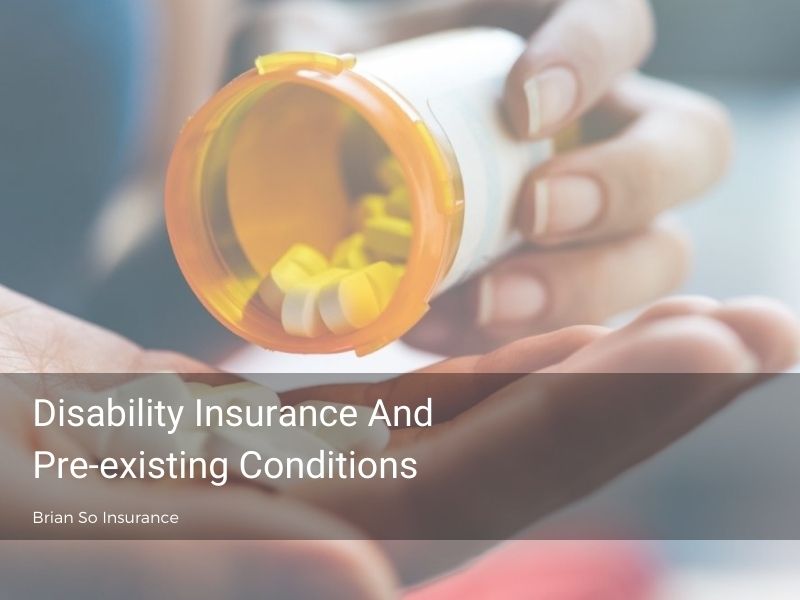
A pre-existing condition is any health issue that existed before your policy takes effect. This includes more than just diagnosed illnesses—it can also include symptoms, treatments, or medical investigations.
For example, if you visited a doctor for recurring back pain or were prescribed medication for anxiety, those will be considered pre-existing conditions—even if they were temporary or resolved.
This broader definition is important because disability insurance focuses on your ability to work, not just your overall health. A condition doesn’t need to be life-threatening to matter. If it has the potential to interfere with your job, it becomes relevant to insurers.
This is why conditions like stress, mild depression, or joint pain often receive more attention in disability insurance than in life insurance. They are common, unpredictable, and closely tied to a person’s ability to perform their job.
How Disability Insurance Underwriting Works in Canada
Medical underwriting is the process insurers use to evaluate your application and determine your risk level. At its core, the insurer is trying to answer one question:
How likely is this person to become unable to work due to illness or injury?
To answer that, they build a detailed profile using several inputs. Your medical history is a major component, but it’s not the only one. Insurers also consider your occupation and lifestyle, like smoking status, drug use, and driving infractions.
A key point many people miss is that medical underwriting is not just about what condition you have—it’s about how that condition behaves over time. Two people with the same diagnosis can receive completely different outcomes depending on how well the condition is managed.
For example, someone with well-controlled asthma who hasn’t had symptoms in years may be treated very differently from someone with recent flare-ups or hospital visits.
How Pre-Existing Conditions Affect Your Approval for Disability Insurance
When a pre-existing condition is present, insurers rarely treat the application as a simple yes-or-no decision. Instead, they adjust the policy to reflect the level of risk involved.
In practice, this means your outcome will usually fall into one of several categories:
Standard approval
- Full coverage with no restrictions
- Priced at normal rates based on your age, gender, and occupation
- Typically requires a mild condition with strong stability (e.g., no treatment for 1–2+ years)
Rated policy
- Higher premium to reflect increased overall risk
- Common for conditions like controlled diabetes, high blood pressure, or obesity
- Coverage is still intact—no limitations on what conditions are covered
Modified policy
- Coverage is restricted in specific ways to manage risk
- Most commonly includes exclusions for certain conditions (e.g., back, mental health)
- May also involve shorter benefit periods or longer waiting periods for related claims
Alternative offer
- Offered when traditional coverage isn’t suitable
- May include simplified issue or accident-only policies
- Lower coverage amounts and more limitations, but easier to qualify
Decline
- Application is not approved due to high or unpredictable risk
- Often tied to active, severe, or progressive conditions
- Doesn’t mean you’re uninsurable forever—timing or different products may change the outcome
The important takeaway is that most people are still approved in some form. The structure of the policy is what changes—not necessarily your ability to get coverage.
The Three Factors That Matter Most to Insurers
Severity of the condition
Severity refers to how serious the condition is and how much it affects your daily functioning. A mild, occasional issue is very different from a chronic or progressive condition.
For instance, occasional migraines may be viewed as manageable, while a neurological condition that affects coordination or cognition would be considered significantly higher risk.
Stability and control
Stability is often the most important factor in underwriting decisions. Insurers want to see that your condition is predictable and well-managed.
This typically means:
- No recent flare-ups or relapses
- Consistent treatment or medication
- No frequent changes in dosage
- Regular follow-ups with your doctor
A condition that has been stable for 12 to 24 months is generally viewed much more favourably than one that has required recent attention.
Risk of recurrence or complications
Some conditions are one-time events, while others tend to come back or worsen over time. Insurers pay close attention to this distinction.
A fully healed injury with no lingering issues presents a lower risk. In contrast, chronic conditions like diabetes or autoimmune disorders carry the possibility of future complications, which increases the likelihood of a claim.
This is also where comorbidities come into play. Multiple related conditions—such as obesity combined with high blood pressure—can significantly increase overall risk.
How Common Conditions Are Viewed for Disability Insurance
Not all pre-existing conditions are treated equally. Insurers assess them based on how predictable they are and how likely they are to lead to a disability claim.
| Condition Type | How Insurers View It | Likely Outcome |
|---|---|---|
| Mental health (anxiety, depression) | High recurrence, subjective symptoms | Standard (mild) to exclusion or 2-year limit |
| Back and joint issues | High claim frequency, hard to measure objectively | Exclusion (especially spine) or rating |
| Cancer | Contingent on the stage at diagnosis, severity and treatment results | Standard to exclusion or rating or decline |
| Diabetes / metabolic | Depends on control and complications | Standard to rated or decline |
| Cardiovascular (BP, cholesterol) | Focus on stability and medication | Standard to rated |
| Respiratory (asthma) | Severity and history of flare-ups matter | Standard to exclusion or decline |
| Gastrointestinal (Crohn’s, GERD) | Chronic flare-up risk | Standard to exclusion or rating |
What stands out is that mental health and musculoskeletal conditions dominate disability claims in Canada. Because of this, insurers tend to apply more conservative underwriting in these areas.
This doesn’t mean you can’t get coverage—it simply means you’re more likely to see adjustments to your policy.
When Disability Insurance May Not Be Available
There are situations where traditional disability insurance isn’t offered—at least not right away. This usually comes down to risk and timing. If an insurer believes there is a high probability of a claim in the near future, they may not be able to approve coverage.
This doesn’t mean you’re permanently uninsurable. In many cases, it simply means your condition is too recent, unstable, or severe at the time of application.
Situations that often lead to postponement or decline
Insurers are more cautious when a condition shows signs of ongoing risk, such as:
- Active or ongoing treatment (e.g., recent therapy, medication changes)
- Recent diagnoses or medical events (e.g., heart attack, cancer within the past year)
- Frequent flare-ups or relapses (e.g., uncontrolled Crohn’s disease or chronic back pain)
- Pending tests or unclear diagnoses
In these cases, the insurer may postpone your application and ask you to reapply after a period of stability.
Conditions that are automatic declines
Some conditions carry such a high and predictable risk of disability that insurers will typically decline individual coverage altogether. These are usually progressive or severe conditions where future disability is considered likely.
Common examples include:
- Progressive neurological disorders (e.g., multiple sclerosis, ALS, Parkinson’s disease)
- Severe mental health conditions (e.g., schizophrenia, recent bipolar disorder episodes)
- Advanced organ disease (e.g., kidney failure, cirrhosis of the liver)
- Active cancer or recent cancer treatment
- Severe autoimmune diseases with ongoing activity (e.g., lupus with complications)
These conditions fall outside what insurers can reasonably price for individual disability coverage.
Your Disability Insurance Options If You Have a Pre-Existing Condition
If traditional coverage is limited, the goal shifts from finding perfect coverage to securing the best available protection.
Individual fully underwritten policies remain the most comprehensive option. These policies offer strong definitions and long-term protection, but they require full medical approval.
For those who may not qualify, simplified issue policies provide an alternative. These policies are easier to obtain because they require fewer medical questions, but they typically come with lower coverage limits and higher costs.
Group disability insurance, often provided through employers, can also be valuable. It usually does not require medical underwriting at the start, making it accessible to those with health conditions. However, it comes with limitations, such as capped benefits and lack of portability.
In some cases, accident-only coverage may be the only option available. While it doesn’t cover illness, it still provides meaningful protection against unexpected injuries.
Can You Improve Your Chances of Approval?
Improving your chances of approval is less about luck and more about timing and strategy.
Applying during a period of stability can significantly improve your outcome. Insurers are more comfortable when your condition has been controlled for a consistent period, rather than recently treated.
Following your doctor’s recommendations and maintaining consistent treatment also matters. Gaps in treatment or non-compliance can raise concerns about future risk.
One of the most important steps is working with an experienced insurance advisor. A knowledgeable advisor can often speak with underwriters before you formally apply, giving you a clear expectation of what to expect.
This approach helps you:
- Avoid unnecessary applications that could result in declines
- Understand whether exclusions or ratings are likely
- Choose the insurer most favourable to your specific condition
This level of preparation can make a meaningful difference in your final outcome.
Reconsideration: Can You Get Better Terms Later?
Many people assume that once a policy is issued, the terms are permanent. In reality, that’s not always the case.
If your condition improves over time, you may be able to request a reassessment. This process allows the insurer to review updated medical information and potentially remove exclusions or reduce premium ratings.
For example, someone with a history of anxiety may initially receive a policy with a mental health exclusion. After several years without symptoms or medication, they may be able to have that exclusion removed.
Reconsideration timelines vary, but they generally depend on how long the condition has remained stable. Minor conditions may require only a year or two, while more serious conditions may require several years of documented improvement.
Individual vs Group Coverage and Pre-Existing Conditions
Individual and group disability insurance handle pre-existing conditions very differently, and understanding this distinction is critical.
Individual policies are underwritten upfront. This means any limitations are clearly defined at the start, and there are fewer surprises later.
Group policies, on the other hand, often provide immediate coverage without medical underwriting. However, they typically include a “look-back period.” If you make a claim early in your coverage, the insurer may review your prior medical history to determine whether the condition existed before you joined the plan.
This can lead to unexpected claim denials, even if you were initially approved for coverage.
Real-Life Example
Consider Sarah, a 38-year-old self-employed marketing professional applying for disability insurance. She has a history of mild anxiety, which was treated with short-term medication and a few counselling sessions. Over the past year, her condition has been stable—no medication, no missed work, and no ongoing treatment.
When Sarah applies, the insurer approves her—but with a mental health exclusion.
At first, she’s concerned. It feels like a major limitation. But after reviewing the policy and speaking with her advisor, she realizes that the exclusion is more limited than she initially thought.
- The exclusion only applies to mental health-related claims
- She remains fully covered for all other causes of disability, such as cancer, heart disease, injuries, and other illnesses
- Most disabilities are caused by new, unrelated conditions—not past medical history
- She can apply to remove the exclusion later if she maintains stability and shows continued improvement
With that perspective, Sarah decides to move forward. The policy still protects her income against a wide range of risks, and it gives her the opportunity to improve her coverage over time.
The key takeaway is that even with an exclusion, disability insurance can still provide significant value—and may become more comprehensive as your health improves.
Cost of Disability Insurance With Pre-Existing Conditions
The cost of disability insurance is influenced by several factors, including your age, occupation, income, and overall health.
When it comes to pre-existing conditions, the impact on cost depends on how the insurer manages the risk.
If your policy includes an exclusion for a specific condition, your premium is typically unchanged. You are essentially paying the same rate as someone without that condition, but with limited coverage for that particular risk.
Premium increases only occur when the insurer applies a rating to reflect higher overall risk. These increases can vary widely depending on the severity and stability of the condition.
As a general guideline, disability insurance premiums can cost 1% to 4% of your income per year, depending on your profile and coverage.
Frequently Asked Questions
Yes, but the insurer will usually exclude that condition. If it is severe or unstable, your application may be postponed or declined until your condition improves.
They review your application, doctor’s reports, and medical records. Insurers may also access prescription histories and industry databases.
It is used in group plans. If you claim within the first year, the insurer reviews your medical history before coverage started to determine if the condition was pre-existing.
Yes. You are still covered for many other disabilities such as cancer, heart disease, or injuries unrelated to that condition.
It depends. Minor conditions may require 1–2 years of stability, while major illnesses may require 3–5 years or more.
Yes. You can provide additional medical evidence or specialist reports to request a reconsideration from the insurer.
Not always. If it is well-controlled and stable, you may still qualify for standard rates depending on other risk factors.
Your policy could be voided, and any claim denied. Full disclosure is critical when applying for disability insurance.
It can be easier to qualify for, but it usually offers less coverage and higher costs compared to fully underwritten policies.
Yes, in some cases. If your condition improves and remains stable, you can request a reassessment from the insurer.
Final Verdict: Can You Get Disability Insurance With a Pre-Existing Condition?
Yes—many Canadians with pre-existing conditions can still get disability insurance.
You may not receive perfect coverage right away, but that doesn’t mean you should go without protection. Even a policy with limitations can provide meaningful financial security—and can often be improved over time.
The key is approaching the process strategically and understanding how insurers evaluate risk.
If you want clarity on your options or how your specific condition will be viewed, reach out for a personalized, no-obligation consultation.
📧 Email: info@briansoinsurance.com
📞 Call: 604-928-1628
Or use the form below to get a quick quote.
Get Your Disability Insurance Quote Now

While we make every effort to keep our site updated, please be aware that timely information on this page, such as quote estimates, or pertinent details about companies, may only be accurate as of its last edit day. Brian So Insurance and its representatives do not give legal or tax advice. Please consult your own legal or tax adviser. This post is a brief summary for indicative purposes only. It does not include all terms, conditions, limitations, exclusions, and other provisions of the policies described, some of which may be material to the policy selection. Please refer to the actual policy documents for complete details which can be provided upon request. In case of any discrepancy, the language in the actual policy documents will prevail. A.M. Best financial strength ratings displayed are not a warranty of a company’s financial strength and ability to meet its obligations to policyholders.